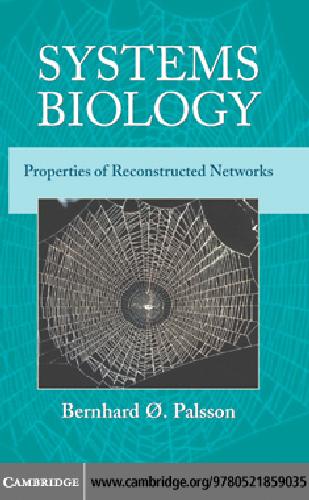
Genome sequences are now available that enable us to determine the biological components that make up a cell or an organism. The new discipline of systems biology examines how these components interact and form networks, and how the networks generate whole cell functions corresponding to observable phenotypes. This textbook describes how to model networks, determine their properties, and relate these to phenotypic functions. Some knowledge of linear algebra and biochemistry is required, since the book reflects the irreversible trend of increasing mathematical content in biology education.
![[PDF] Species Diagnostics Protocols: PCR and Other Nucleic Acid Methods Justin P. Clapp](https://digzon.com/wp-content/uploads/2024/04/4e617342281e8d36ac1f1e29f777541a-d.jpg)
![[PDF] Transgenesis Techniques: Principles and Protocols Jim McWhir (auth.), Alan R. Clarke (eds.)](https://digzon.com/wp-content/uploads/2024/04/084e8b47194af92f4c856ea76bd5cbd4-d.jpg)
![[PDF] Atomic Force Microscopy: Biomedical Methods and Applications Pier Carlo Braga, Davide Ricci](https://digzon.com/wp-content/uploads/2024/04/91210a008c9b99652ef2cf31753ab54a-d.jpg)
![[PDF] Combinatorial Peptide Library Protocols Shmuel Cabilly](https://digzon.com/wp-content/uploads/2024/04/544771fd1a042be83962a076eba5a957-d.jpg)
Reviews
There are no reviews yet.