Our goal is to understand the properties of macroscopic systems, that is, systems of many electrons, atoms, molecules, photons, or other constituents. Examples of familiar macroscopic objects include systems such as the air in your room, a glass of water, a copper coin, and a rubber band (examples of a gas, liquid, solid, and polymer, respectively). Less familiar macroscopic systems are superconductors, cell membranes, the brain, and the galaxies.
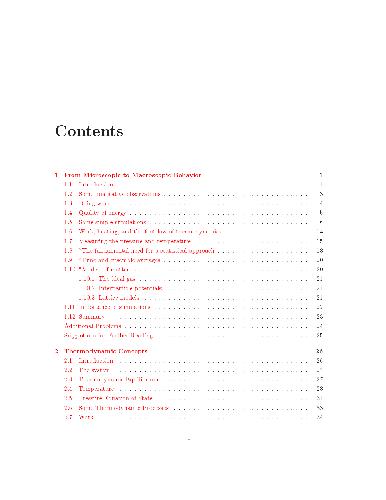
![[PDF] Thermal and Statistical Physics H. Gould, J. Tobochnik](https://digzon.com/wp-content/uploads/2024/04/5daaa51efe6749fa4e0bd63c26617739.jpg)
![[PDF] Tensors and the Clifford algebra: application to the physics of bosons and fermions Alphonse Charlier, Alain Berard, Marie-France Charlier, Daniele Fristot](https://digzon.com/wp-content/uploads/2024/04/c88292e8a0002aa49fc6e417fbe29c7e-d.jpg)
![[PDF] The topology of fibre bundles Norman Steenrod](https://digzon.com/wp-content/uploads/2024/04/2ef66b6104ea65926f7ad1541698a36c-d.jpg)
![[PDF] Airy functions and applications in physics Olivier Vallee, manuel Soares](https://digzon.com/wp-content/uploads/2024/04/636d27cfbe0971e1c313de247decc7fe-d.jpg)
![[PDF] Geometry, Topology, and Physics Mikio Nakahara](https://digzon.com/wp-content/uploads/2024/04/cb8d747f8e524461c4c18b71f5173da9-d.jpg)
Reviews
There are no reviews yet.