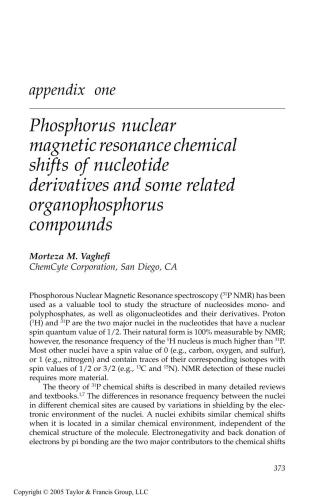
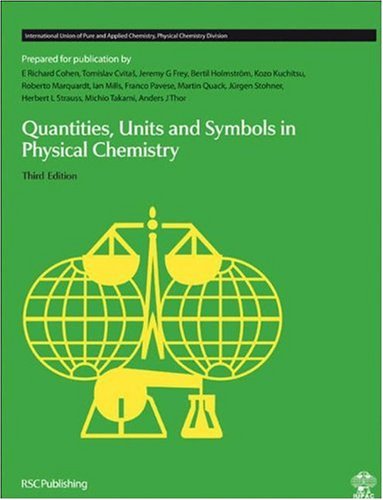
Today’s scientists face a bewildering array of standards they should adopt to ensure effective communication across different formats (different journals, books, and electronic media). This guide helps authors recognize which symbols have the IUPAC impramatur and which should be avoided for clarity. This guide still has deficiencies. For example, it has very few guidelines for the different arrows employed to denote different sorts of reactions. Different usages are common in the literature, and it would be best if IUPAC would unify the field.
Chemistry
[PDF] Quantities, units, and symbols in physical chemistry E Richard Cohen, Tom Cvitas, Jeremy G Frey, Bertil Holstrom, John W Jost
$19.99
![[PDF] Quantities, units, and symbols in physical chemistry E Richard Cohen, Tom Cvitas, Jeremy G Frey, Bertil Holstrom, John W Jost](https://digzon.com/wp-content/uploads/2024/04/2bd1d5ec21e90e09fc4f330ff2bc391f-d.jpg)
![[PDF] Organic Chemistry John E. McMurry](https://digzon.com/wp-content/uploads/2024/04/762fb8eca198b029296a19bb0921cbe3-d.jpg)
![[PDF] Key Skills for Scientists: Getting the Message Across Kristy Macdonald](https://digzon.com/wp-content/uploads/2024/04/4050cd06e4b1f1de76252b8a1bc589f4-d.jpg)
![[PDF] Oxidation and Antioxidants in Organic Chemistry and Biology](https://digzon.com/wp-content/uploads/2024/04/4531EEE28496696702F127FE97789B47-g.jpg)
![[PDF] Nucleoside Triphosphates and their Analogs. Chemistry, Biotechnology, and Biological Applications Morteza Vaghefi](https://digzon.com/wp-content/uploads/2024/04/400F3C2C0B373F35499B06C5062D72A7-g.jpg)
Reviews
There are no reviews yet.