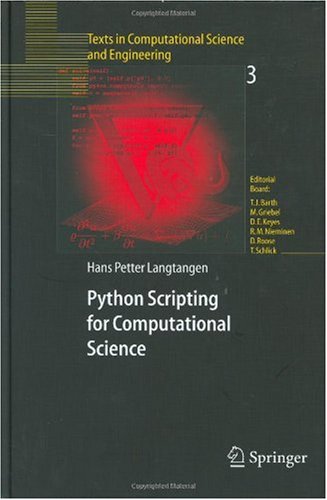
The goal of this book is to teach computational scientists and engineers how to develop tailored, flexible, and efficient working environments built from small programs (scripts) written in the easy-to-learn, very high-level language Python. The focus is on examples and applications of relevance to computational science: gluing existing applications and tools, e.g. for automating simulation, data analysis, and visualization; steering simulations and computational experiments; equipping programs with graphical user interfaces; making computational Web services; creating interactive interfaces with a Maple/Matlab-like syntax to numerical applications in C/C++ or Fortran; and building flexible object-oriented programming interfaces to existing C/C++ or Fortran libraries. In short, scripting with Python makes you much more productive, increases the reliability of your scientific work and lets you have more fun – under Unix, Windows and MacIntosh.
Reviews
There are no reviews yet.