
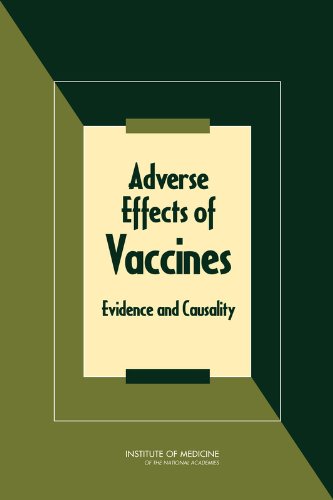
In 1900, for every 1,000 babies born in the United States, 100 would die before their first birthday, often due to infectious diseases. Today, vaccines exist for many viral and bacterial diseases. The National Childhood Vaccine Injury Act, passed in 1986, was intended to bolster vaccine research and development through the federal coordination of vaccine initiatives and to provide relief to vaccine manufacturers facing financial burdens. The legislation also intended to address concerns about the safety of vaccines by instituting a compensation program, setting up a passive surveillance system for vaccine adverse events, and by providing information to consumers. A key component of the legislation required the U.S. Department of Health and Human Services to collaborate with the Institute of Medicine to assess concerns about the safety of vaccines and potential adverse events, especially in children.
Adverse Effects of Vaccines reviews the epidemiological, clinical, and biological evidence regarding adverse health events associated with specific vaccines covered by the National Vaccine Injury Compensation Program (VICP), including the varicella zoster vaccine, influenza vaccines, the hepatitis B vaccine, and the human papillomavirus vaccine, among others. For each possible adverse event, the report reviews peer-reviewed primary studies, summarizes their findings, and evaluates the epidemiological, clinical, and biological evidence. It finds that while no vaccine is 100 percent safe, very few adverse events are shown to be caused by vaccines. In addition, the evidence shows that vaccines do not cause several conditions. For example, the MMR vaccine is not associated with autism or childhood diabetes. Also, the DTaP vaccine is not associated with diabetes and the influenza vaccine given as a shot does not exacerbate asthma.
Adverse Effects of Vaccines will be of special interest to the National Vaccine Program Office, the VICP, the Centers for Disease Control and Prevention, vaccine safety researchers and manufacturers, parents, caregivers, and health professionals in the private and public sectors.
![[PDF] Corporate Restructuring and Industrial Research and Development The Academy Industry Program of the National Academy of, National Academy of Engineering, Institute of Medicine](https://digzon.com/wp-content/uploads/2024/04/d2935cd8c4c6572d459316429d08d607-d.jpg)
![[PDF] Examining Core Elements of International Research Collaboration: Summary of a Workshop Planning Committee for the Workshop on Examining Core Elements of International Collaboration, Government-University-Industry Research Roundtable, Policy and Global Affairs, National Academy of Sciences, National Academy of Engineering, Institute of Medicine, National Academies](https://digzon.com/wp-content/uploads/2024/04/a9b9db48499d3922735bc14b92026e3f-g.jpg)
![[PDF] Expanding Underrepresented Minority Participation: America's Science and Technology Talent at the Crossroads Committee on Underrepresented Groups and the Expansion of the Science and Engineering Workforce Pipeline, Engineering, and Public Policy Committee on Science, Policy and Global Affairs, National Academy of Sciences, National Academy of Engineering, Institute of Medicine](https://digzon.com/wp-content/uploads/2024/04/ac9a96ac97de7427f2198307b58fc816-d.jpg)
![[PDF] Improving Palliative Care for Cancer National Cancer Policy Board, National Research Council, Institute of Medicine, Kathleen M. Foley, Hellen Gelband](https://digzon.com/wp-content/uploads/2024/04/247a324e47180910fba8cb4666a4c304-d.jpg)
Reviews
There are no reviews yet.