This up-to-date account of key areas in modern organic spectroscopy describes the four major instrumental methods used routinely by organic chemists: ultra-violet/visible, infra-red, nuclear magnetic resonance spectroscopy, and mass spectroscopy. It provides a concise introduction to the physical background of each, describing how molecules interact with electromagnetic radiation or how they fragment when excited sufficiently, and how this information may be applied to the determination of chemical structures. It also includes simple descriptions of instrumentation and emphasizes modern methodology throughout, such as the Fourier-transform approach to data analysis. Each chapter concludes with problems to test readers’ understanding of organic spectroscopy
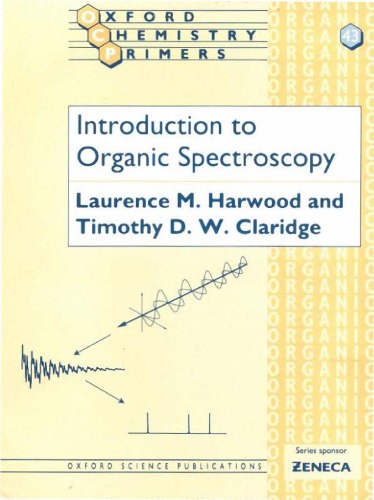
![[PDF] Introduction to organic spectroscopy Laurence M Harwood; Timothy D W Claridge](https://digzon.com/wp-content/uploads/2024/04/b72da330cf6f5bf590df769f08bfaac0-g.jpg)
![[PDF] Acoustic Microscopy (Monographs on the Physics and Chemistry of Materials) Andrew Briggs, Oleg Kolosov](https://digzon.com/wp-content/uploads/2024/04/27189cd37a8025cdc7d7c1049f0e3131-d.jpg)
![[PDF] Theory of planetary atmospheres : an introduction to their physics
and chemistry / Joseph W. Chamberlain](https://digzon.com/wp-content/uploads/2024/04/02d53f740a0c345e2b422f3cc6db8225-d.jpg)
![[PDF] Organic chemistry Carter K.](https://digzon.com/wp-content/uploads/2024/04/6f05f85102fb907648fab4bd42501301-g.jpg)
![[PDF] AP Chemistry For Dummies Peter J. Mikulecky PhD, Michelle Rose Gilman, Kate Brutlag](https://digzon.com/wp-content/uploads/2024/04/cb32e4a03a39a0b1d59dbb2e9e86bda6-d.jpg)
Reviews
There are no reviews yet.