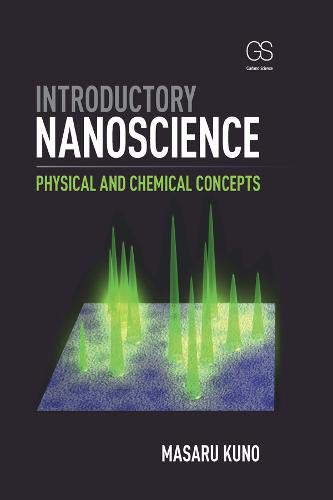
Designed for upper-level undergraduate and graduate students, Introductory Nanoscience asks key questions about the quantitative concepts that underlie this new field. How are the optical and electrical properties of nanomaterials dependent upon size, shape, and morphology? How do we construct nanometer-sized objects? Using solved examples throughout the chapters, this textbook shows to what extent we may predict the behavior and functionality of nanomaterials by understanding how their properties change with scale. Fundamental concepts are reinforced through end-of-chapter problems and further reading. Students will appreciate complete derivations of relevant equations, simplified assumptions for practical calculations, listed references, and a historical overview about the development of colloidal quantum dots.
![[PDF] Introductory Nanoscience: Physical and Chemical Concepts Masaru Kuno](https://digzon.com/wp-content/uploads/2024/04/7bf985343dca4c66737dc26d9d7d239c-d.jpg)
![[PDF] Internal structure of black holes and spacetime singularities: an international research workshop, Haifa, June 29-July 3, 1997 Lior M. Burko, Amos Ori](https://digzon.com/wp-content/uploads/2024/04/46a9df64ddfafed1242af5b54d4e1198.jpg)
![[PDF] Nonlinear Physical Oceanography: A Dynamical Systems Approach to the Large Scale Ocean Circulation and El Ni?o Henk A. Dijkstra (auth.)](https://digzon.com/wp-content/uploads/2024/04/1a462233e561e42865288fd15fd09804-d.jpg)
![[PDF] Physical optics S. A. Akhmanov, S. Yu. Nikitin](https://digzon.com/wp-content/uploads/2024/04/40029bcd8b367451b62579da8634bb15-d.jpg)
![[PDF] Mathematical and Physical Aspects of Stochastic Mechanics Ph. Blanchard, Ph. Combe, W. Zheng (auth.)](https://digzon.com/wp-content/uploads/2024/04/AF80DEC379A414B8BDA6F3F36FB69558-d.png)
Reviews
There are no reviews yet.