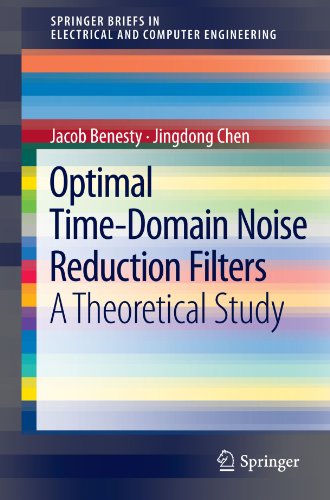
Additive noise is ubiquitous in acoustics environments and can affect the intelligibility and quality of speech signals. Therefore, a so-called noise reduction algorithm is required to mitigate the effect of the noise that is picked up by the microphones. This work proposes a general framework in the time domain for the single and multiple microphone cases, from which it is very convenient to derive, study, and analyze all kind of optimal noise reduction filters. Not only that all known algorithms can be deduced from this approach, shedding more light on how they function, but new ones can be discovered as well.
Engineering
[PDF] Optimal Time-Domain Noise Reduction Filters: A Theoretical Study Jacob Benesty, Jingdong Chen (auth.)
$19.99
![[PDF] Optimal Time-Domain Noise Reduction Filters: A Theoretical Study Jacob Benesty, Jingdong Chen (auth.)](https://digzon.com/wp-content/uploads/2024/04/e29e940812b0467cd234d362e4c99eb0-d.jpg)
![[PDF] Thin Films for Optical Systems Flory](https://digzon.com/wp-content/uploads/2024/04/355a7341fb0f0a3d89c5354d26758455-d.jpg)
![[PDF] System Engineering for IMS Networks Arun Handa](https://digzon.com/wp-content/uploads/2024/04/eb79124e09062754b7353a240f695040-d.jpg)
![[PDF] Tunable Laser Applications F. J. Duarte](https://digzon.com/wp-content/uploads/2024/04/b857583d53868d4da6835e1a61c683d1-d.jpg)
![[PDF] Target Costing Market Driven Product Design Bradford Clifton, Henry M. B. Bird, Robert E. Albano, Wesley P. Townsend](https://digzon.com/wp-content/uploads/2024/04/4e650508f73c24afe8407df4f95a25c8-d.jpg)
Reviews
There are no reviews yet.