
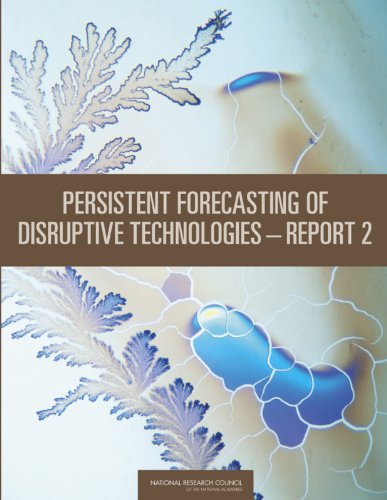
The term “disruptive technology” describes a technology that results in a sudden change affecting already established technologies or markets. Disruptive technologies cause one or more discontinuities in the normal evolutionary life cycle of technology. This may lead to an unexpected destabilization of an older technology order and an opportunity for new competitors to displace incumbents. Frequently cited examples include digital photography and desktop publishing.
The first report of the series, Persistent Forecasting of Disruptive Technologies, discussed how technology forecasts were historically made, assessed various existing forecasting systems, and identified desirable attributes of a next-generation persistent long-term forecasting system for disruptive technologies. This second book attempts to sketch out high-level forecasting system designs. In addition, the book provides further evaluation of the system attributes defined in the first report, and evidence of the feasibility of creating a system with those attributes. Together, the reports are intended to help the Department of Defense and the intelligence community identify and develop a forecasting system that will assist in detecting and tracking global technology trends, producing persistent long-term forecasts of disruptive technologies, and characterizing their potential impact on future U.S. warfighting and homeland defense capabilities.

![[PDF] Life and Physical Sciences Research for a New Era of Space Exploration: An Interim Report Committee for the Decadal Survey on Biological and Physical Sciences in Space, Space Studies Board, National Research Council](https://digzon.com/wp-content/uploads/2024/04/135f520341cc9a89cbd0d99ea392421d-d.jpg)
![[PDF] Making Sense of Ballistic Missile Defense: An Assessment of Concepts and Systems for U.S. Boost-Phase Missile Defense in Comparison to Other Alternatives Committee on an Assessment of Concepts and Systems for U.S. Boost-Phase Missile Defense in Comparison to Other Alternatives, Division on Engineering and Physical Science, National Research Council](https://digzon.com/wp-content/uploads/2024/04/e80506bf24b7839b268690c43e32d8ba-g.jpg)
Reviews
There are no reviews yet.