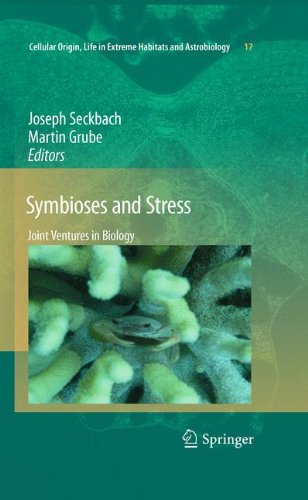
Symbioses and Stress centers on the question of how organisms in tight symbiotic associations cope with various types of abiotic and biotic stress. In its original sense, symbioses cover all kinds of interactions among unrelated organisms, whereas in a narrower concept, the term is often referred to as mutualism. Evolutionary biology recognizes symbiosis as an integrative process, and most fundamental evolutionary innovations arose from cooperative symbioses. Mutualisms contribute to stress tolerance, ecosystem stability, and evolutionary radiation of cooperating organisms. Modern eukaryotic cells are the result of the endosymbiotic union of prokaryotic ancestors as well as diverse exosymbiotic associations. This cooperative aggregation appears more successful than its independent parts. This new book presents functional and evolutionary aspects of mutually beneficial symbioses among unrelated organisms.
Biology
{pdf} Symbioses and Stress: Joint Ventures in Biology Jan Sapp (auth.), Joseph Seckbach, Martin Grube (eds.)
$19.99
![[PDF] Capillary Electrophoresis of Nucleic Acids: Volume I: Introduction to the Capillary Electrophoresis of Nucleic Acids Keith R. Mitchelson (auth.), Keith R. Mitchelson, Jing Cheng (eds.)](https://digzon.com/wp-content/uploads/2024/04/0F4BC1B0ED98497EE2A493A06639905E-d.jpg)
![[PDF] Cell Cycle Checkpoints and Cancer Mikhail V. Blagosklonny](https://digzon.com/wp-content/uploads/2024/04/845ed102aa89d763a5250ad1d5f2fd17-d.jpg)
![[PDF] Species Diagnostics Protocols: PCR and Other Nucleic Acid Methods Justin P. Clapp](https://digzon.com/wp-content/uploads/2024/04/4e617342281e8d36ac1f1e29f777541a-d.jpg)
![[PDF] Transgenesis Techniques: Principles and Protocols Jim McWhir (auth.), Alan R. Clarke (eds.)](https://digzon.com/wp-content/uploads/2024/04/084e8b47194af92f4c856ea76bd5cbd4-d.jpg)
Reviews
There are no reviews yet.