
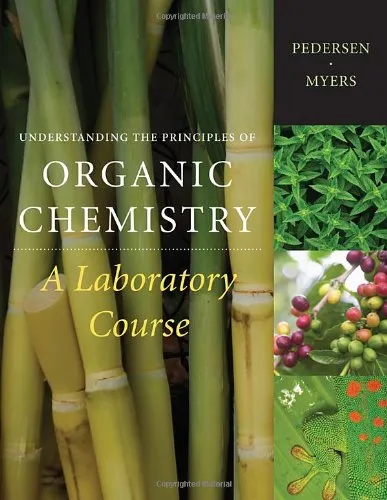
Principles of Organic Chemistry are far easier to master when theory meets the bench, and that is exactly what Understanding the Principles of Organic Chemistry: A Laboratory Course by Steven F. Pedersen and Arlyn M. Myers was built for. This instant-download PDF gathers 36 class-tested experiments already used by thousands of students in real teaching laboratories.
Built around simple equipment and green chemistry ideas, the manual introduces traditional synthetic methods alongside recently developed ones. Many procedures are drawn from the current literature and are not found in other lab manuals, which makes this book a genuinely fresh companion for a first- or second-year organic sequence.
What makes this Principles of Organic Chemistry lab course different
Most lab manuals recycle the same handful of reactions year after year. This one focuses on safety, gives students repeated practice in the core techniques used in the organic lab, and includes a strong microscale component that cuts both reagent cost and chemical waste. Because the equipment list stays deliberately simple, a department can run the entire sequence without buying specialised glassware or dedicated instrumentation.
The 36 experiments at a glance
- Distillation, recrystallisation and melting-point determination
- Liquid-liquid extraction, drying agents and solvent selection
- Thin-layer chromatography and column chromatography
- Infrared, NMR and mass-spectrometry interpretation
- Nucleophilic substitution and elimination reactions
- Aldol condensation, Grignard and Diels-Alder syntheses
- Microscale oxidation and reduction procedures
- Green chemistry alternatives to classic preparations
Each experiment is written as a complete unit: background, hazards, procedure, expected yields, and a set of end-of-experiment questions that push students to explain what they observed rather than simply report it.
Who this Principles of Organic Chemistry PDF is for
- Undergraduates taking a two-semester organic chemistry sequence
- Pre-med, pharmacy and biochemistry students preparing for practical exams
- Teaching assistants who need reliable pre-lab notes and timings
- Instructors rebuilding a laboratory syllabus around microscale work
- Self-learners who want structured bench work instead of isolated recipes
Green chemistry and laboratory safety
Safety is treated as part of the chemistry, not as an appendix. Every experiment states the hazards, the working scale and the disposal route before the procedure begins. The green chemistry framing — reduced solvent volumes, safer reagents and microscale glassware — also lowers the environmental footprint of a teaching lab, an approach promoted by the ACS Green Chemistry Institute and consistent with the naming and reporting standards published by IUPAC.
Instructor resources included
An Online Instructor’s Manual, hosted on the publisher’s instructor companion website, adds instructors’ notes, pre-lab meeting notes, realistic experiment completion times, full answers to the end-of-experiment questions, and video clips demonstrating key techniques. For anyone coordinating several parallel lab sections, those timing tables alone save an entire semester of guesswork.
Book details
- Title: Understanding the Principles of Organic Chemistry: A Laboratory Course
- Authors: Steven F. Pedersen, Arlyn M. Myers
- Format: PDF, instant download after payment
- Experiments: 36 class-tested procedures
- Focus: microscale techniques, green chemistry, safety, spectroscopy
Download the Principles of Organic Chemistry PDF today
Checkout takes about a minute and the download link is delivered immediately after payment, so you can start reading before your next lab session. You can also browse our full chemistry ebooks collection or explore the wider DIGZON digital library for related science and engineering titles.
Frequently asked questions
Do I need a fully equipped laboratory to use this book?
No. The experiments were selected precisely because they run on simple, standard equipment, and the microscale versions reduce the glassware and reagent quantities even further.
Does the PDF include the Instructor’s Manual?
The Instructor’s Manual is hosted separately on the publisher’s companion website and is reserved for verified instructors. This product is the student laboratory course itself.
Is this book suitable for self-study?
Yes. Because each of the 36 experiments explains the underlying Principles of Organic Chemistry before the procedure, the manual also works well as a structured reading companion for anyone revising organic reaction mechanisms on their own.
![[PDF] Electron Tunneling in Chemistry R. G. Compton](https://digzon.com/wp-content/uploads/2024/04/5342eb532008580f3648bae0be2e8915-d.jpg)
![[PDF] Delay differential equations and applications O. Arino, M.L. Hbid, E. Ait Dads](https://digzon.com/wp-content/uploads/2024/04/be9d2e0262a23ae19943e5b07fd8674a-d.jpg)
![[PDF] Computational Chemistry of Solid State Materials: A Guide for Materials Scientists, Chemists, Physicists and others Richard Dronskowski, Roald Hoffmann](https://digzon.com/wp-content/uploads/2024/04/744ffde821df5ae4bfaeab377a519844-d.jpg)
![[PDF] AP Chemistry For Dummies Peter J. Mikulecky PhD, Michelle Rose Gilman, Kate Brutlag](https://digzon.com/wp-content/uploads/2024/04/cb32e4a03a39a0b1d59dbb2e9e86bda6-d.jpg)
Reviews
There are no reviews yet.